Engineered Door & Window Solutions for Modern Projects
Engineered for high-humidity cooking zones, luxury terrace transitions, and residential thermal barriers. Explore our primary export series manufactured under stringent EN 14351-1 CE testing criteria.
Structural Engineering & CE Compliance Under EN 14351-1 Standards
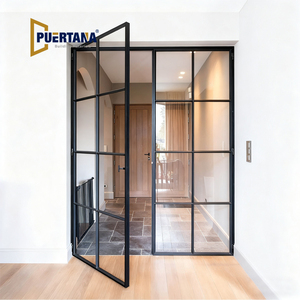
In contemporary architectural design, commercial kitchens, luxury culinary suites, and multi-family residential food prep areas require door assemblies that surpass typical interior partition criteria. A kitchen door is constantly exposed to high relative humidity, fluctuating ambient temperatures, vaporized cooking oils, and heavy mechanical cycling. As professional CE certified aluminium kitchen doors suppliers & exporters, Guangdong Dejiyoupin Doors and Windows Co., Ltd. (DERCHI) engineers solutions that integrate European standard building physics into every extrusion.
Compliance with EN 14351-1 (Windows and doors - Product standard, performance characteristics) is not merely a bureaucratic prerequisite for entering the European Economic Area; it guarantees measurable mechanical durability, watertightness, air permeability, and thermal insulation performance. Utilizing high-tensile 6063-T6 architectural aluminium alloy, our kitchen partitions and balcony transition doors provide unmatched structural rigidity with narrow sightlines, enabling maximum light penetration without succumbing to thermal deflection.
| Performance Characteristic | Test Standard / Benchmark | DERCHI Kitchen Door Specification | Architectural Benefit |
|---|---|---|---|
| Thermal Transmittance (Ud) | EN ISO 10077-1 / EN ISO 10077-2 | 0.9 – 1.4 W/(m²·K) (Thermal Break Series) | Prevents condensation in humid cooking spaces and saves HVAC energy. |
| Air Permeability | EN 1026 / EN 12207 | Class 4 (Hermetic EPDM Multi-Gasket Sealing) | Isolates culinary odors, grease vapor, and smoke from adjacent living spaces. |
| Acoustic Isolation | EN ISO 10140-2 / EN ISO 717-1 | Rw = 32 dB to 42 dB (Depending on Glazing Configuration) | Suppresses high-frequency exhaust hood noise and culinary machinery clatter. |
| Operating Forces & Durability | EN 12046-2 / EN 1191 | Class 2 / Exceeds 100,000 Opening Cycles | Smooth operation under high-frequency residential and hospitality usage. |
| Corrosion Resistance | EN 1670 (Hardware) / Qualicoat (Profiles) | Grade 5 (Hardware) / Powder Coat & Fluorocarbon ≥ 60μm | Immune to grease-induced oxidation, alkaline cleaners, and salt-fog degradation. |
The fundamental differentiator of our export assemblies lies in the precision joinery of the sub-frame and sash. Unlike low-cost screwed corners that suffer from sagging and diagonal racking over time, DERCHI systems utilize automated injection corner crimping combined with two-component German polyurethane adhesive. This prevents air infiltration gaps and ensures lifelong dimensional stability across wide openings.
Procurement Trends Shaping the Next Decade (2025–2035)
In-depth market intelligence for commercial contractors, overseas developers, and regional importers adjusting their sourcing portfolios.
Ultra-Low Carbon & Recycled Billets
European green procurement mandates (such as the EU Corporate Sustainability Due Diligence Directive and Carbon Border Adjustment Mechanism - CBAM) are compelling commercial developers to verify profile provenance.
- Shift toward certified low-carbon primary aluminium with Hydro or similar verified smelting footprints.
- Post-consumer scrap integration reaching >45% without degrading tensile yield strength.
- Demands for complete Environmental Product Declarations (EPDs) accompanying every bill of lading.
Minimalist Sightlines with Maximum Structural Rigidity
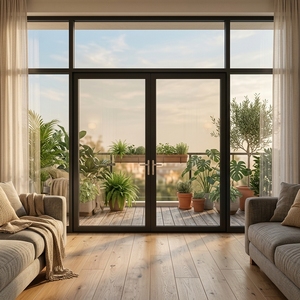
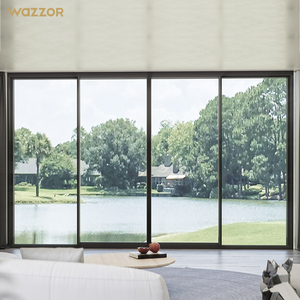
Architects are eliminating heavy mullions between open-plan kitchen spaces and outdoor entertainment terraces, driving the demand for concealed sub-frames and flush floor tracks.
- Interlocking stile profiles down to 18mm–25mm while supporting up to 450kg pane weights.
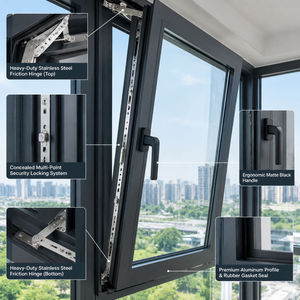
- Concealed multi-point lock actuators hidden inside the profile rebate for uninterrupted visual flow.
- Barrier-free, flush-to-floor track drainage compliant with universal accessibility regulations (DIN 18040).
Prefabricated Glazing & Rapid Site Deployment
Mounting labor costs across Europe, North America, and Australia are shifting the procurement preference from on-site glazing to factory-calibrated, unitized installations.
- Pre-glazed sliding and swing units featuring structural silicone dry-glazing technology.
- Integrated sub-frame installation clips designed for rapid mounting onto steel or light-gauge frames.
- Zero on-site glass cutting or gasket adjustment, cutting commercial fit-out timelines by over 40%.
Technology Trajectory: How Aluminium Kitchen Doors Are Evolving
Bridging traditional joinery and high-tech architectural automation to overcome historical functional pain points.
Phase 1: Basic Non-Thermal Partitions
Historically, interior kitchen doors utilized simple cold-rolled profiles with single 4mm annealed glass. These assemblies transmitted airborne noise, transferred condensation onto dining floors, and suffered frame sagging under grease exposure.
- No acoustic damping (Rw < 20 dB).
- Prone to rail jamming from debris accumulation.
- Vulnerable to surface tarnishing from cleaning agents.
Phase 2: Thermal Break & Insulated Units (Current)
The standard benchmark today. Extrusions incorporate PA66 GF25 polyamide thermal break strips, double-glazed warm edge units with argon gas, and multi-point perimeter compression seals to isolate heat and acoustic pollution.
- Ud values tuned to specific climate requirements (0.9 to 1.6 W/m²K).
- Patented Four-Side Six-Point locking hardware for intruder protection.
- Precision heavy-duty rollers rated for 100,000+ flawless gliding cycles.
Phase 3: Smart Glass, Sensor Automation & Hygiene Tech
Next-generation luxury kitchen portals integrating electrochromic PDLC privacy switchable glass, touchless proximity radar sensors, and active antimicrobial fluoropolymer surface coatings.
- Instant optical transition from clear to frosted via Building Automation Systems.
- Integrated magnetic soft-close dampeners to prevent slamming in tight food-prep quarters.
- Oleophobic, easy-clean nano-coatings that prevent culinary grease adhesion.
Enterprise Advantages: Why DERCHI Dominates Global Supply Chains
Guangdong Dejiyoupin Doors and Windows Co., Ltd. delivers direct factory engineering leverage to importers, builders, and architects worldwide.

180,000m² Smart Base
Unmatched footprint in Foshan featuring robotic profile machining centers and multi-line parallel manufacturing capacity.

1,000,000m²+ Annual Output
High throughput eliminates project scheduling bottlenecks, supporting large-scale high-rise and villa community orders.

100+ Core Patents
Proprietary inventions including the Four-Side Six-Point Lock for superior air compression and structural anti-theft security.

360° Zero-Error QC
Every frame undergoes automated coordinate inspection, water-tightness chamber testing, and millimetric hardware tolerance audits.

Multi-National Certifications
Full verification coverage including CE (Europe EN 14351-1), NFRC (USA), AS2047 (Australia), CSA (Canada), and ISO 9001.

30+ Senior Engineers
Dedicated R&D wing offering shop drawing review, wind load calculation, static profile modeling, and bespoke extrusion development.

Full Whole-Home Portfolio
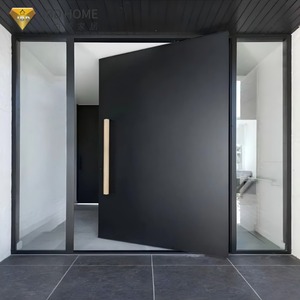
Synchronize kitchen portals, main pivot entryways, balustrades, sunrooms, and tilt-turn windows with uniform RAL powder finishes.

Xinhua Certified Brand
Designated as a China Famous Brand by Xinhua News Agency, backed by $435M+ annual project volume across 300+ global partners.
Frequently Asked Questions: Global Sourcing & Compliance
Actionable guidance compiled by our export logistics and engineering departments to streamline your importing workflow.
What specific CE documentation is supplied for customs clearance and European building control?
For every shipment destined for the European Union or UK market, we provide a complete technical dossier complying with Construction Products Regulation (CPR 305/2011) and EN 14351-1. This includes an official Declaration of Performance (DoP), laboratory test reports from accredited notified bodies detailing air permeability (EN 12207), watertightness (EN 12208), wind load resistance (EN 12211), and thermal simulation reports for calculated Ud values. Each unit is clearly labelled with the appropriate CE marking indicating production batch, year of manufacture, and performance class.
How do you ensure kitchen doors withstand grease accumulation and frequent chemical sanitation?
We apply electrostatic polyester powder coatings conforming strictly to Qualicoat Class 2 standards or high-thickness architectural anodizing (minimum 20–25 microns). These finishes undergo neutral salt spray testing exceeding 1,000 hours and demonstrate complete resistance to household saponified fats, weak acids, cooking wine, and alkaline cleaning detergents. Furthermore, our EPDM sealing gaskets are sulfur-free and oil-resistant, preventing swelling, hardening, or cracking over decades of kitchen vapor exposure.
Can DERCHI configure kitchen door assemblies to satisfy regional energy codes like GEG, RE2020, or Part L?
Yes. European thermal requirements vary significantly—from Germany's strict Gebäudeenergiegesetz (GEG) requiring Ud values down to 1.0–1.2 W/m²K, to France's RE2020 and the UK's Approved Document Part L. By varying our polyamide thermal strut widths (from 24mm up to 34mm multi-chamber Technoform strips) and specifying triple-glazed Low-E insulating glass units (IGUs) with warm-edge spacers and argon gas fill, our technical department custom-engineers door assemblies that hit your precise regional target without over-engineering profile costs.
What is your export crating methodology to prevent glass breakage or frame deformation during sea freight?
Export shipments traveling via ocean freight face severe hydrodynamic acceleration and humidity changes. We employ a five-layer packaging protocol: 1) Protective PE film on all exposed profile surfaces; 2) High-density corrugated corner guards; 3) Bubble-wrap vapor barrier encapsulation; 4) Steel-strapped, fully enclosed non-coniferous fumigation-free plywood crates; and 5) Internal rubber shock-dampening runners to keep the crated assemblies stabilized during heavy sea swells. Detailed container load planning is performed via 3D software to ensure optimal weight distribution and prevent cargo movement.
What is the minimum order quantity (MOQ) and lead time for custom project specifications?
Because we operate a flexible 180,000m² manufacturing facility, our MOQ is tailored to the project profile. For custom bespoke luxury villas, we accept orders starting from single whole-house packages (comprising kitchen, entry, and exterior openings). For commercial residential developments and wholesale distributors, production runs typically scale from 20-foot to 40-foot full container loads (FCL). Typical production lead time ranges from 25 to 35 calendar days following shop drawing confirmation and glass specification sign-off.
How does DERCHI support foreign installation teams who have never handled Chinese profile systems?
We eliminate installation guesswork by providing comprehensive bilingual (English/French/German/Spanish) installation manuals, exploded 3D CAD anchor schematics, and pre-packaged assembly hardware tailored to your specific wall construction (concrete, steel frame, or timber). Additionally, we provide step-by-step video installation demonstrations and offer live video technical support directly with our senior site engineers during the rough-in and adjustment phase.
Initiate Your Technical Proposal & Factory-Direct Quotation
Send your project opening schedule, required U-values, or architectural blueprints. Our senior export engineering department will return a comprehensive structural review and itemized proposal within 24 hours.